
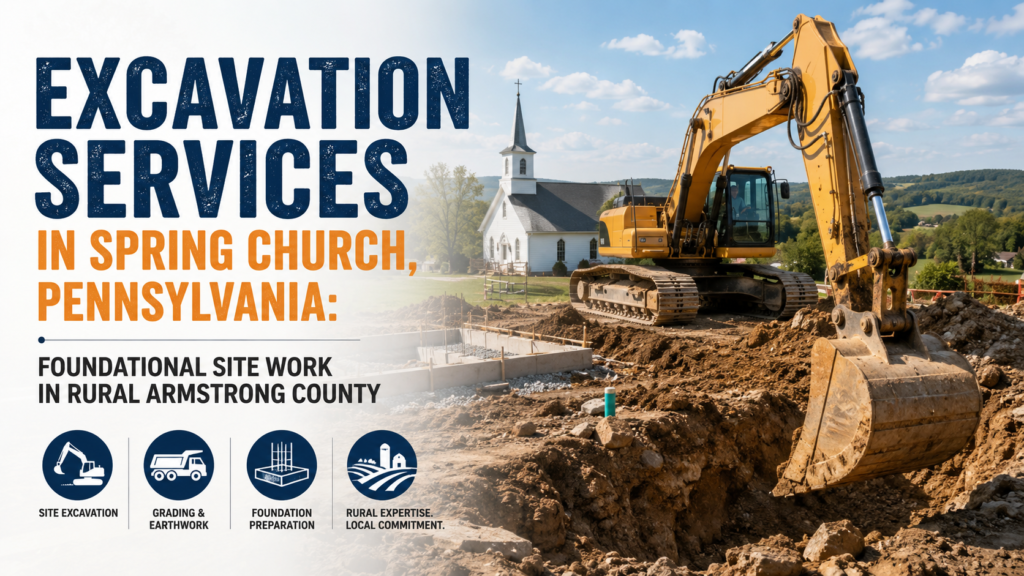
Excavation is the unglamorous but essential first step behind nearly every construction project, drainage improvement, and site development undertaking in Spring Church, Pennsylvania and the surrounding rural communities of Armstrong County. Whether the project is a new home foundation, a septic system installation, a farm pond, or simple driveway preparation, the quality of the Excavation Service Spring Church work that happens before any visible construction begins determines the long-term success of everything built on top of it. Understanding what excavation contractors do, how Armstrong County distinctive geology and terrain shape this work, and what property owners should know before any ground is disturbed provides a useful foundation for planning projects in this part of Western Pennsylvania.
What Excavation Contractors Provide
Excavation contractors operate the heavy equipment and bring the technical expertise required for earth-moving and below-grade site preparation. In the Spring Church area, this work spans a range of applications:
- Site clearing and grubbing: Removing vegetation, stumps, and surface material from areas planned for construction or other development.
- Rough and finish grading: Reshaping terrain to establish design elevations, drainage slopes, and a stable sub-grade ready for construction.
- Foundation excavation: Digging to the required depth for residential basements, foundation footings, and concrete slabs.
- Utility trenching: Excavating trenches for water lines, electrical conduit, and other underground utility infrastructure.
- Septic system excavation: A particularly important service in rural Armstrong County, where many properties rely on on-site septic systems rather than municipal sewer service.
- Driveway and access road sub-base preparation: Excavating and grading to the appropriate depth and slope before aggregate base and paving materials are installed.
- Pond and farm water feature construction: Excavating farm ponds and drainage improvements common on the area many agricultural and rural residential properties.
Armstrong County Geology and Its Effect on Excavation
Armstrong County sits within the Appalachian Plateau region, and its underlying geology dominated by sedimentary shale, sandstone, and coal-bearing strata characteristic of Western Pennsylvania coalfields creates excavation conditions distinct from much of the rest of the state. Property owners and excavation contractors in the Spring Church area regularly encounter:
- Shallow rock: Sandstone and shale formations can be encountered at relatively shallow depths on hillside properties throughout the Kiskiminetas valley, sometimes requiring specialized rock excavation equipment when standard excavation reaches bedrock sooner than anticipated.
- Weathering shale: Shale that is freshly exposed to air and moisture during excavation can deteriorate relatively quickly compared to harder rock types, requiring prompt stabilization measures once exposed.
- Clay-influenced valley soils: The soils overlying bedrock in the river valley portions of Armstrong County often contain significant clay content, which retains moisture, expands and contracts seasonally, and presents specific bearing-capacity considerations for foundation and pavement sub-grade work.
Septic System Excavation: A Critical Rural Service
Because Spring Church and much of rural Armstrong County are not served by municipal sewer infrastructure, on-site septic systems handle wastewater treatment for the large majority of properties in the area. Septic system design and installation in Pennsylvania is governed by state Department of Environmental Protection regulations as well as county sewage enforcement oversight, and the process begins with a site evaluation by a licensed soil evaluator to determine percolation rates and appropriate system sizing for the specific soil and site conditions.
Excavation for septic systems in this context typically involves digging the pit for the septic tank, installing the tank, and excavating the trenches for the distribution lines and drain field stone at the depth and configuration specified in the approved system design. Where site conditions are limiting shallow rock, high water table, or slow soil percolation alternative system designs such as elevated mound systems may be required, involving the construction of an engineered, elevated drain field using imported sand fill. Throughout the installation, coordination with the Armstrong County sewage enforcement officer and required inspections at key construction stages are necessary before the system is covered and put into service.
Pennsylvania One Call: The Mandatory First Step
Before any excavation begins in Spring Church or anywhere else in Pennsylvania, state law requires notification to the Pennsylvania One Call system (811) at least three business days in advance. This notification prompts utility companies to locate and mark the position of buried infrastructure natural gas pipelines, electrical conduit, water lines, and telecommunications cables with color-coded flags or paint at the project site.
This requirement carries particular weight in Armstrong County given the region significant natural gas infrastructure, which includes both distribution lines serving homes and businesses and production-related infrastructure connected to the area long history of natural gas extraction, including more recent Marcellus Shale activity. Striking an underground gas line or other utility during excavation can result in explosions, electrocution, service disruptions, and serious safety consequences making the 811 notification a genuine safety requirement rather than bureaucratic formality.
Drainage: A Defining Excavation Challenge in Hilly Terrain
The rolling, hilly terrain of the Kiskiminetas River valley around Spring Church makes water management a central and recurring challenge in excavation work throughout the area. Armstrong County receives approximately 40 inches of annual precipitation, and the area sloped landscape concentrates runoff into valleys and low-lying areas where many properties, roads, and structures are situated. Excavation contractors address this reality at several levels: shaping surface grades during site preparation to direct runoff away from structures and toward appropriate outlets; installing subsurface perforated drain systems where groundwater or seasonally high water tables threaten to saturate foundation areas; constructing diversion ditches above building or paving areas to intercept hillside runoff before it reaches the developed site; and installing culverts, headwalls, and other structures to manage concentrated water flow safely.
Equipment for Rural Excavation Work
The specific equipment deployed for excavation projects in the Spring Church area depends on project scale, site access, and the nature of the work. Mini excavators are well suited to confined residential sites, landscaping work, and utility trenching where access is limited. Standard excavators handle foundation work, larger trenching, and general earthmoving. Bulldozers are appropriate for larger-scale clearing and rough grading on open agricultural or development sites. Dump trucks are required for hauling excavated material off-site or distributing fill material across a project area. Selecting equipment appropriately scaled to the specific project and site conditions is part of the planning that experienced local excavation contractors bring to Armstrong County projects.
Conclusion
Excavation services in Spring Church and rural Armstrong County form the essential starting point for the area construction, septic system, and site improvement projects. The region distinctive geology, hilly terrain, and reliance on on-site wastewater systems all shape how this foundational work must be approached. Property owners who understand what excavation involves from utility notification through septic system requirements to the drainage management that the area terrain demands are better equipped to plan their projects and work effectively with the local contractors who understand these conditions firsthand.